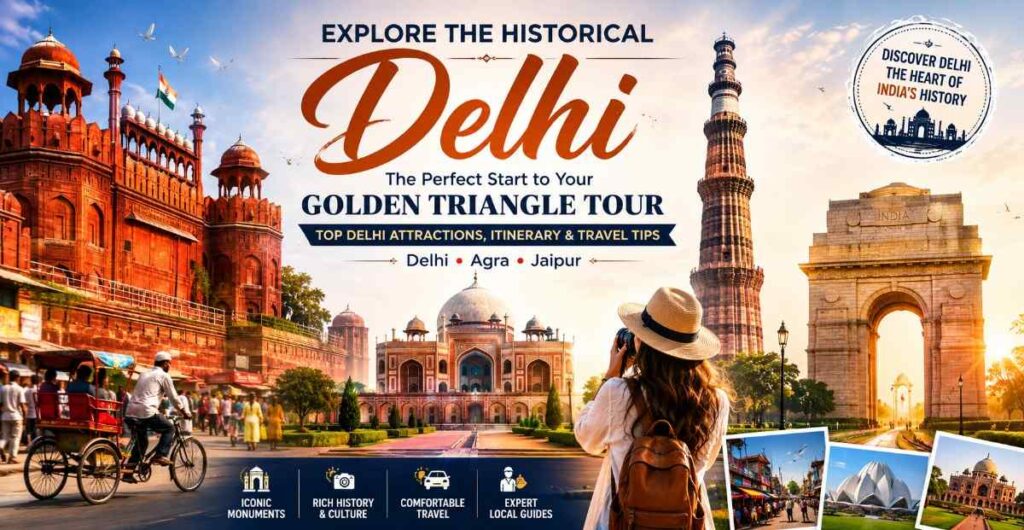
Delhi is where every Golden Triangle Tour itinerary begins, and for good reason. Long before it became India’s capital, Delhi was built and rebuilt by seven different ruling powers, each leaving behind forts, tombs, and gateways that still stand today. Walking through Old Delhi’s narrow lanes or the wide colonial boulevards of New Delhi, you’re really walking through a timeline — the Delhi Sultanate, the Mughal Empire, the British Raj, and independent India, all layered into one city.
For travelers starting a Delhi Agra Jaipur tour, spending even a day or two on Delhi sightseeing places sets the context for everything that follows — the Mughal architecture you’ll see in Agra and the Rajput forts of Jaipur all trace back to stories that begin here. This guide walks through the best Delhi tourist attractions worth prioritizing, how they fit into a well-paced Golden Triangle Tour itinerary, and how to experience them comfortably on a luxury Golden Triangle Tour with Travelcix.
Why Delhi Is the Perfect Start to a Golden Triangle Tour Itinerary
Delhi isn’t just a stopover — it’s the city where the entire arc of North Indian history is visible in a single day’s walk. The Delhi Sultanate’s earliest monuments sit a short drive from the grandeur of Mughal-era forts and mosques, which in turn sit close to the British-built government quarter of New Delhi. This layering gives first-time visitors a sense of scale and continuity before they ever set foot in Agra or Jaipur. Practically speaking, Delhi is also the most convenient starting point: it has India’s busiest international airport and excellent road and rail connections to Agra and Jaipur, which is exactly why most Golden Triangle Tour Packages begin here.
Top Delhi Tourist Attractions You Cannot Miss
Whether you have a full day or just a few hours, these are the Delhi sightseeing places that consistently make it onto every well-planned Golden Triangle Tour Delhi attractions list.
Red Fort (Lal Qila)
Built by Emperor Shah Jahan in 1638, the Red Fort served as the seat of Mughal power for nearly two centuries and remains one of Delhi’s most recognisable UNESCO World Heritage Sites. Its massive red sandstone walls enclose the Diwan-i-Aam (Hall of Public Audience), ornate marble pavilions, and a small museum chronicling India’s freedom movement. The evening sound-and-light show is a popular way to experience its history after dark.
Humayun’s Tomb
Commissioned in the 1560s by Empress Bega Begum for her husband, Emperor Humayun, this garden tomb is widely considered the architectural ancestor of the Taj Mahal you’ll later visit in Agra. Set within a Persian-style charbagh garden, it was India’s first grand garden tomb and a clear precursor to the design language that defines Mughal monuments across the Golden Triangle.
Qutub Minar
Construction on this soaring brick minaret began in 1192 under Qutb-ud-din Aibak to mark the start of Muslim rule in Delhi. At 73 metres, it remains the tallest brick minaret in the world. The surrounding complex, including the iron pillar that has resisted rust for over 1,600 years, offers a fascinating look at early Indo-Islamic architecture.
Jama Masjid
India’s largest mosque, also commissioned by Shah Jahan, overlooks the bustling lanes of Old Delhi from its sandstone plinth. The courtyard can hold up to 25,000 worshippers, and climbing one of its minarets rewards visitors with sweeping views over the old city’s rooftops.
India Gate and Rashtrapati Bhavan
Shifting from Mughal to colonial history, India Gate is a 42-metre war memorial honouring soldiers of the British Indian Army, while nearby Rashtrapati Bhavan — the President’s official residence — showcases the grand, planned avenues of Lutyens’ Delhi. Together they represent the 20th-century chapter of the city’s layered past.
Raj Ghat
A simple black marble platform marks the site where Mahatma Gandhi was cremated in 1948. Set within quiet, well-tended gardens, Raj Ghat offers a reflective contrast to the grandeur of Delhi’s forts and palaces, and is a meaningful stop for anyone interested in India’s path to independence.
Chandni Chowk — Old Delhi’s Living Heritage
Laid out in the 17th century by Jahanara, Shah Jahan’s daughter, Chandni Chowk is less a single monument and more a living museum of trade, food, and craftsmanship. Wander its spice lanes, the famous Paranthe Wali Gali, and centuries-old jewellery markets on a guided Old Delhi heritage walk for the most authentic sense of how Old Delhi actually lives and breathes today.
Best Delhi Sightseeing Places for a Half-Day or Full-Day Tour
If your schedule is tight, you don’t need a full week to see Delhi’s highlights. A Half-Day Old Delhi Tour comfortably covers the Red Fort, Jama Masjid, and Chandni Chowk in around four hours, while a Half-Day New Delhi Tour pairs well with it to take in India Gate, Humayun’s Tomb, and Qutub Minar by car.
For travellers who want it all in a single day, the One-Day Old & New Delhi Hidden Gems Tour by Car combines both eras of the city into one well-paced itinerary. Browse the full range of New Delhi Tour Packages to pick the duration and pace that best fits your trip.
How Delhi’s Monuments Connect to the Rest of Your Golden Triangle Tour Itinerary
Once Delhi’s historical sites are covered, the Golden Triangle Tour itinerary naturally continues to Agra, home to the Taj Mahal and Agra Fort, and then to Jaipur, Rajasthan’s Pink City. The design language you’ll have just seen at Humayun’s Tomb and the Red Fort reappears, refined further, in Agra’s monuments — making the Taj Mahal and Agra day tour by car feel like a continuation of the same story rather than a separate trip.
From there, a One Day Jaipur Tour by Car from Delhi or a longer stay completes the loop with Rajput forts and palaces. Travellers who want to go deeper into the region can extend further with a full Rajasthan Tour Package covering Udaipur, Jodhpur, and Jaisalmer.
Experience a Luxury Golden Triangle Tour with Travelcix
Travelcix has been arranging guided journeys across North India since 2014 and is recognised by the Ministry of Tourism, Government of India, along with back-to-back Tripadvisor Travellers’ Choice Awards in 2022 and 2023. For travellers who want Delhi’s history delivered without the logistics of getting there, our luxury Golden Triangle Tour packages bundle private air-conditioned transport, skip-the-line entry at major monuments, and licensed, multilingual local guides.
Choose from flexible durations, including the 4-day, 5-day, and 6-day Golden Triangle Tour itineraries, each pairing Delhi’s monuments with the Taj Mahal in Agra and the forts of Jaipur. Comfortable car rental services with professional drivers are available throughout, so the only thing you need to plan is what to see next.
Practical Tips for Exploring Delhi’s Historical Places
- Visit between October and March for the most comfortable sightseeing weather; Delhi summers can be intensely hot.
- Start early — most monuments, including the Red Fort and Qutub Minar, are far less crowded right after opening.
- Dress modestly when visiting Jama Masjid and other religious sites; scarves are usually available to borrow at the entrance.
- Hire a licensed local guide for context you won’t get from a plaque — the stories behind each dynasty are often more interesting than the architecture itself.
- Book private, air-conditioned transport between sites so you spend your time sightseeing rather than navigating Delhi’s traffic.
Frequently Asked Questions
What are the top historical places to visit in Delhi during a Golden Triangle Tour?
The Red Fort, Humayun’s Tomb, Qutub Minar, Jama Masjid, India Gate, Raj Ghat, and Chandni Chowk are the must-see Delhi tourist attractions that most Golden Triangle Tour itineraries include.
How many days do I need in Delhi for a Golden Triangle Tour itinerary?
One full day or two half-days is usually enough to cover Delhi’s key historical sites before continuing to Agra and Jaipur, though history lovers may prefer an extra day to explore at a slower pace.
Is Delhi sightseeing included in a luxury Golden Triangle Tour package?
Yes. Travelcix’s luxury Golden Triangle Tour packages include guided Delhi sightseeing, private air-conditioned transport, and licensed local guides as part of the itinerary.
What is the best time of year to visit Delhi’s historical attractions?
October to March offers the most comfortable weather for exploring Delhi’s monuments, with cooler mornings that are ideal for outdoor sightseeing.
Can I customize my Delhi sightseeing itinerary with Travelcix?
Yes, Travelcix offers fully customizable Delhi and Golden Triangle Tour itineraries, letting you choose the monuments, pace, and duration that suit your travel style.
Plan Your Golden Triangle Tour Today
Delhi’s forts, tombs, and bazaars are more than a checklist — they’re the opening chapter of a journey that continues through Agra’s marble monuments and Jaipur’s pink-hued palaces. Let Travelcix take care of the routes, the guides, and the logistics, so all that’s left for you to do is take it in. Plan your trip with Travelcix and start your Golden Triangle Tour the right way — in Delhi.