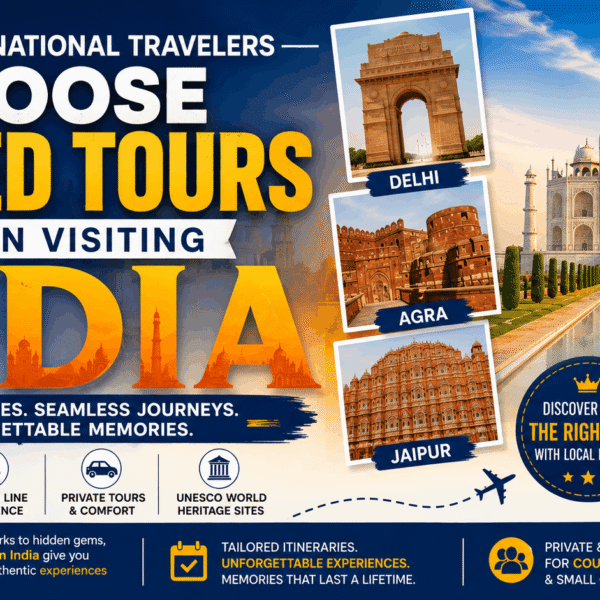
If you’re mapping out your first trip to India, chances are the Golden Triangle is already on your list. Delhi, Agra, and Jaipur pack in Mughal forts, the Taj Mahal, pink-hued palaces, and bazaars that smell like cardamom and dust — all within a few hours’ drive of each other. It’s the most popular route in the country for a reason.
But here’s the thing: because it’s so popular, a lot of travellers assume it plans itself. It doesn’t. Every year, people rush their Golden Triangle itinerary, underestimate distances, or book the wrong transport, and end up spending more time in traffic than at the Taj. So before you lock in your dates, let’s walk through the most common Golden Triangle itinerary mistakes travellers make — and exactly how to avoid them, drawn from what actual tour operators like Travelcix see happen on the ground every season.
What Exactly Is the Golden Triangle Tour?
Quick refresher for anyone new to the term: the Golden Triangle Tour connects three cities — Delhi, Agra, and Jaipur — that form a rough triangle on the map of North India. Delhi gives you the capital’s layered history, from the Red Fort to Humayun’s Tomb. Agra is home to the Taj Mahal and Agra Fort. And Jaipur, the Pink City, brings Rajasthani forts, palaces, and colour into the mix. Most people cover all three in one trip because they’re close together and the contrast between them is what makes the journey memorable.
Now, onto the mistakes.
Mistake 1: Getting the Golden Triangle Tour Duration Wrong
This is the number one planning error. People either cram Delhi, Agra, and Jaipur into 3 rushed days, or they book two full weeks and run out of things to do. The right Golden Triangle tour duration really depends on your travel style, not a fixed number.
As a rough guide:
- 2–3 days (1 Night 2 Days Agra & Jaipur Tour or a 3-Day Golden Triangle Tour) — good if you only have a long weekend and want the highlights fast.
- 4–5 days (the 4-Day or 5-Day Golden Triangle Tour) — the sweet spot for most first-timers, with breathing room in each city.
- 6–7 days (the 6-Day or 7-Day Golden Triangle Tour) — ideal if you want slower mornings, extra monuments, or a day trip to Fatehpur Sikri along the way.
- 9 days and beyond — for travellers combining the classic route with add-ons like Ranthambore, Varanasi, or a deeper Rajasthan tour through Udaipur and Jodhpur.
The fix here is simple: decide what you actually want to see before you fix your dates, not the other way around. If heritage and photography matter to you, don’t try to squeeze it into 3 days — you’ll spend it all in the car.
Mistake 2: Not Setting a Realistic Golden Triangle Travel Budget
A surprising number of travellers book flights and hotels first, then figure out the rest of their Golden Triangle travel budget as they go. That’s how people end up overpaying for last-minute transport or skipping monuments because they didn’t budget for entry fees.
Before you book anything, account for these five categories:
- Transport between cities (private car, train, or a mix)
- Accommodation (3-star, 4-star, or 5-star — this swings the total the most)
- Monument entry fees, including the Taj Mahal, Agra Fort, and Amber Fort
- Meals — street food is cheap, but hotel buffets add up fast
- A local guide, which is genuinely worth the small extra cost
If you’re travelling on a tighter budget, a budget Golden Triangle itinerary doesn’t have to mean a worse experience — it usually just means choosing 3-star stays over 5-star, and picking a shorter, well-planned route like the 3-Day or 4-Day Golden Triangle Tour instead of a longer luxury package. On the other end, if budget isn’t a constraint, Travelcix’s Luxury Golden Triangle Tour packages (4, 5, or 6 days) bundle in premium hotels and a more relaxed pace.
Mistake 3: Choosing the Wrong Mode of Transport
This is where a lot of trips go sideways. Travellers either book a Golden Triangle tour by train without realising it locks them into fixed timings, or they book a Golden Triangle by private car without checking road conditions and journey length. Both are valid — the trick is matching the mode to your priorities.
A private car tour gives you full flexibility: stop for photos, take a detour to Fatehpur Sikri, adjust your pace, and travel door-to-door with a professional driver. It’s the more popular choice for the full Delhi–Agra–Jaipur loop because the cities aren’t always well connected by direct trains.
A train journey, on the other hand, is brilliant for the Delhi–Agra leg specifically. The superfast trains cover that stretch in around two hours, which is faster than driving, and it’s a comfortable option if you just want a same-day Taj Mahal visit without an overnight stay. Many travellers actually combine both — train to Agra, then a private car onward to Jaipur — to get the best of both worlds.
Whatever you choose, don’t book transport in isolation. Match it to your itinerary first, then lock in the mode.
Mistake 4: Overpacking the Itinerary (or Underplanning It)
This is probably the most common of all the Golden Triangle itinerary mistakes. Some travellers try to see every single fort, museum, and market in each city and end up exhausted by day two. Others go the opposite way — no real plan, no bookings, and they waste hours figuring things out on the spot.
A workable itinerary usually looks like this:
- Delhi: Red Fort, Humayun’s Tomb, India Gate, and Chandni Chowk — pick 3 or 4, not all of them, unless you have two full days.
- Agra: Taj Mahal and Agra Fort, with Fatehpur Sikri as an optional add-on if you have the extra hours.
- Jaipur: Amber Fort, Hawa Mahal, and City Palace, followed by some downtime in the local bazaars.
If you’d rather not plan this out sentence by sentence, this is exactly what a structured Golden Triangle Tour Package is built for — the stops, timings, and transitions are already worked out so you’re not improvising on day one.
Mistake 5: Ignoring Crowd Timing and Skip-the-Line Entry
The Taj Mahal alone draws thousands of visitors a day, and if you arrive at the wrong hour, you’ll spend more time in the entry queue than actually looking at the monument. This is one of those things nobody tells you until you’ve already stood in line for 40 minutes in the sun.
Booking a tour with skip-the-line entry and going early — ideally at sunrise — makes a real difference, both for the crowd situation and for photos without hundreds of strangers in the background. There’s a good breakdown of this in How to Avoid Crowds at the Taj Mahal, which is worth a quick read before you finalise your Agra day.
Mistake 6: Skipping a Local Guide to Save Money
It’s tempting to go the fully independent route to cut costs, but a good chunk of the Golden Triangle’s value is in the stories behind the monuments — why the Taj Mahal was built, what the carvings on Hawa Mahal represent, which corner of Agra Fort the emperor was imprisoned in. Without a guide, you see the buildings. With one, you understand them.
Government-licensed guides also tend to know the quieter entry points, the best photo angles, and how to time your visit around the crowds — something that’s hard to figure out on your own the first time. If you want this handled properly, Travelcix’s Destination Expert Tour Guide service pairs you with a certified local guide for exactly this.
Mistake 7: Not Checking If the Tour Can Be Customised
Every traveller is different, but a lot of people book the first standard package they find and don’t ask whether it can flex around their actual needs — pickup location, hotel category, extra stops, or a slower pace for kids and senior citizens. Most operators, Travelcix included, allow full customisation of duration, accommodation, and stops, so it’s always worth asking before you assume you’re stuck with a fixed template.
If you want to extend the classic route, popular add-ons include the Golden Triangle with Rajasthan, the Golden Triangle with Ranthambore for a wildlife safari, or the Golden Triangle with Varanasi for a spiritual detour along the Ganges. None of these need to be planned separately — they can simply be added to your existing itinerary.
A Quick Checklist Before You Book
- Fix your must-see list before you fix your tour duration
- Set a realistic Golden Triangle travel budget across transport, stay, entry fees, and food
- Choose private car, train, or a mix — based on flexibility versus speed
- Don’t overpack each day; 3–4 stops per city is plenty
- Book skip-the-line entry and go early for the Taj Mahal
- Add a local guide instead of going fully independent
- Ask about customisation before assuming you’re locked into a fixed package
Frequently Asked Questions
How do I plan a Golden Triangle tour if it’s my first time in India?
Start with your available days, then work backwards. A 5-Day Golden Triangle Tour is the easiest starting point for most first-timers — long enough to see the highlights without feeling rushed.
Is a Golden Triangle tour by private car better than by train?
Neither is objectively better — a private car gives you flexibility for the full loop, while the train is faster specifically for the Delhi–Agra leg. Many travellers combine both.
What’s a realistic budget Golden Triangle itinerary?
A shorter route like the 3-Day or 4-Day tour with 3-star accommodation keeps costs down without cutting out the core sights.
How many days do I actually need?
4 to 7 days covers Delhi, Agra, and Jaipur comfortably. Anything under 3 days means you’ll be prioritising heavily, and anything over 9 days usually includes an extension like Rajasthan or Ranthambore.
Final Thoughts
The Golden Triangle is one of those trips that rewards a bit of upfront planning. Get the duration, budget, and transport right, and the rest — the Taj at sunrise, the forts of Jaipur, the chaos of Chandni Chowk — takes care of itself. If you’d rather skip the guesswork entirely, browse Travelcix’s full range of Golden Triangle Tour Packages or simply get in touch to have an itinerary built around your dates, budget, and travel style.